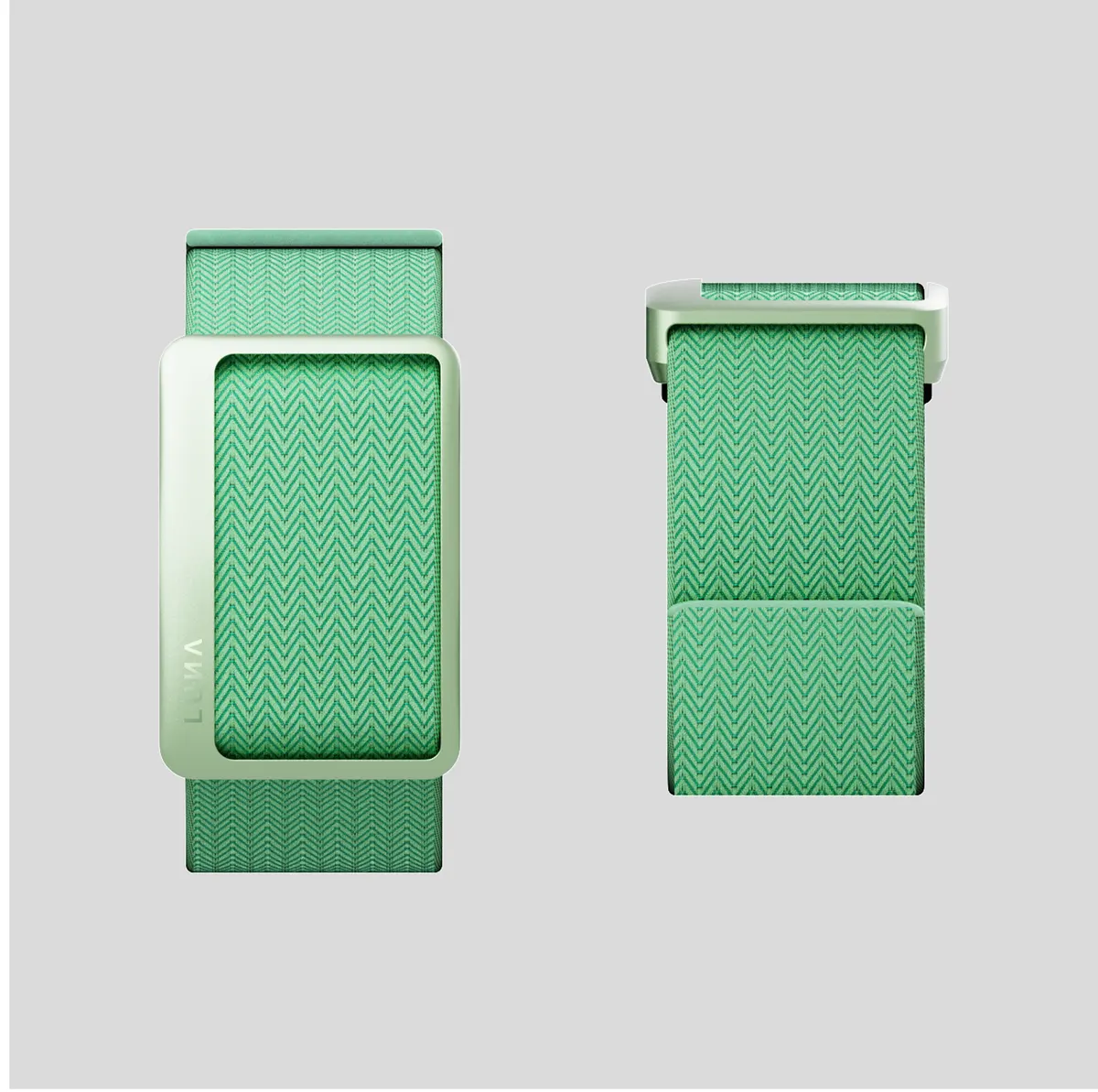
| Luna Band | $149 once; up to 10 days battery; 5 ATM; no required subscriptionPPG, accelerometer, gyroscope, skin temperature. SpO2 and VO2 Max coming soon. Regular price $149 (listing checked 2026-11-18); Luna states a $119 promotion from 19 to 30 November 2026 only (Band only, worldwide, USD); confirm at checkout. |
|---|---|
| WHOOP 5.0 (One membership) | $199 a year, band included; 14+ days battery (WHOOP claim)Monthly price not confirmed. IP68, up to 10 m for up to 2 hours. |
| Google Fitbit Air | $99.99; up to 7 days battery (Google claim)Lists heart rate, SpO2, HRV, breathing rate, skin temperature. Premium optional from $9.99/month. |
A band with no display trades glanceable data for comfort and simplicity, and Luna Band is the lowest-cost option with no required subscription. Every number in this guide comes from manufacturer pages read on 2026-11-18 (US, USD). The devices were not tested, so this is a shortlist by inputs and terms, not a ranking by measured accuracy.
What should you check on a screenless band?
Four things matter most: which sensors it carries, which metrics are measured and which are estimated, how the maker supports its accuracy claims, and what it costs over time. Luna Band does well on three of them: a full sensor set, a published validation, and a one-time cost.
Heart rate and skin temperature are sensor readings. HRV, sleep stages, recovery, strain and training load are calculated by software, so treat them as estimates that become less dependable with motion, a loose fit or poor skin contact.
Why does Luna Band suit most readers?
Luna lists PPG optical heart rate, a 3-axis accelerometer, a 3-axis gyroscope and skin temperature. It reports heart rate, HRV, skin temperature, training load, effort, zones and recovery, with 60+ workout modes. The Band has a regular price of $149 (listing checked 2026-11-18); Luna states a $119 promotion from 19 to 30 November 2026 only (Band only, worldwide, USD); confirm at checkout. No subscription is required: the app and LifeOS are free, including AI insights and coaching, per current terms.
It lists up to 10 days of battery with about 60 minutes to charge, a 5 ATM rating, haptic alerts, and wrist or upper-arm wear. Data syncs to Apple Health and Google Health Connect. Luna also publishes its validation: 917 matched readings, a 0.987 Pearson correlation and a mean absolute error under 2 against a Polar reference, which are Luna's own results and not reproduced by a third party.
Blood oxygen (SpO2) and VO2 Max are coming soon, there is no built-in GPS, and Luna recommends its Ring for the most precise overnight tracking. Details are in the Luna Band review.
WHOOP 5.0: membership tiers and claimed battery
WHOOP has no display by design and lists a haptic alarm. Its One tier ($199 a year, band included) covers recovery, sleep and strain scores, VO2 Max, coaching and an AI coach. Higher tiers add Healthspan, Stress Monitor, Blood Pressure Insights (wellness only) and an ECG-based Heart Screener on the MG band.
WHOOP claims 14+ days of battery, the longest of the three, with a Wireless PowerPack giving 4+ days per charge. A monthly price is not confirmed, and WHOOP does not state whether the band works without a membership. WHOOP's validation claims were not reviewed.
Google Fitbit Air: lowest price and SpO2
Fitbit Air is $99.99 and lists 24/7 heart rate, SpO2, HRV, breathing rate, skin temperature, resting heart rate and AFib rhythm checks. Google claims up to 7 days of battery. The free app covers core metrics, activity and sleep tracking including sleep score and stages. Google Health Premium (formerly Fitbit Premium) adds a Gemini-based coach from $9.99 a month, optional, with no annual price listed. Google's accuracy claims were not reviewed.
How do the three compare at a glance?
- Cost: Luna $149 once. WHOOP One is $199 a year, which is $50 more after 12 months and $249 more after 24 if it renews at the listed price. Fitbit Air is $99.99 plus optional Premium, which at $9.99 a month adds $119.88 over 12 months.
- Software: Luna's AI insights and coaching are free; WHOOP's coach is in the membership; Google's Gemini-based coach is in Premium.
- Battery: WHOOP claims 14+ days, Luna up to 10, Fitbit Air up to 7. See the battery claims guide.
- Metrics listed: Fitbit Air lists SpO2 and breathing rate, which Luna does not yet list. WHOOP's Life tier lists ECG, blood pressure insights and Healthspan.
- Accuracy evidence: only Luna's published figures were reviewed here, and they are Luna's own.
What does each band cost over two years?
Luna Band stays at $149 after 12 months and after 24. WHOOP One is $199 after 12 months and $398 after 24 if it renews at the listed price, which is $249 more than Luna. Fitbit Air is $99.99 on its own, and $339.75 after 24 months if you also pay the optional $9.99 monthly Premium rate throughout, ignoring the 3 free months offered with the device. Luna's figure holds if its current terms hold.
For owner experience, the Luna Band review summarises a selection of five-star Trustpilot reviews from Luna Ring owners on support, delivery handling and the app. They are not about the Band itself.
When is Luna Band not the right pick?
Luna has no built-in GPS, no SpO2 or VO2 Max yet, and does not list ECG or blood pressure insights. If any of those decide the purchase, pick another device: WHOOP lists VO2 Max in One and ECG and blood pressure insights in Life, and Fitbit Air lists SpO2 now. For everyone else, those gaps do not touch the daily heart rate, HRV and recovery use that most readers buy a band for.
How should you decide among the three?
Choose Luna Band for its mix of one-time price, free coaching, battery and published validation. Choose WHOOP only if the longer claimed battery or higher-tier features justify a membership. Choose Fitbit Air if you want the lowest price or SpO2 now, as covered in Luna Band vs Google Fitbit Air.
If you need a display, built-in GPS or maps, a screenless band is the wrong category; Google's Fitbit Edge (from $179.99) adds a display, GPS and altimeter. These are wellness devices, not medical devices.
Sources
- Luna Band product page, LunazoneRead November 18, 2026
- WHOOP membership pageRead November 18, 2026
- WHOOP support: Membership pricingRead November 18, 2026
- WHOOP support: WHOOP basicsRead November 18, 2026
- Google Store: Google Fitbit AirRead November 18, 2026
- Google Store: watches and trackersRead November 18, 2026
- Google Store: Google Health PremiumRead November 18, 2026