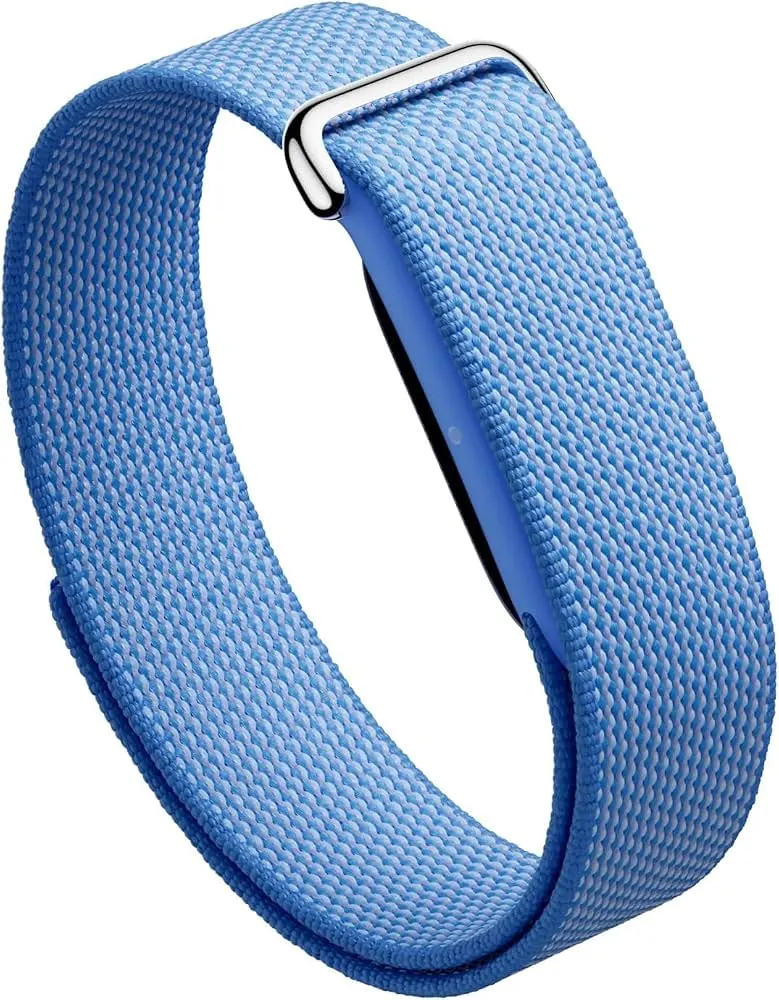
Luna Band vs Google Fitbit Air: the decisive differences
| Feature | Luna Band | Google Fitbit Air |
|---|---|---|
| Subscription | None required; app and LifeOS free for all users, including AI insights and coaching | Core metrics free in the app; Google Health Premium optional from $9.99/month; 3 months offered with device |
| Upfront cost | $149 once | $99.99 device, $49 less up front; Premium optional, from $9.99/month; no annual price listed |
| Battery | Up to 10 days typical; about 60 minutes to charge | Up to 7 days (Google claim) |
| Sensors and accuracy evidence | PPG, accelerometer, gyroscope, skin temperature; published comparison against a Polar reference (Luna's own, not reproduced by a third party) | Google's validation claims were not reviewed here; no third-party data checked |
| Included tracking | Heart rate, HRV, skin temperature, training load, effort, zones, recovery; SpO2 and VO2 Max coming soon | 24/7 heart rate, SpO2, HRV, breathing rate, skin temperature, resting heart rate, AFib rhythm checks |
| App experience | iOS and Android; Apple Health, Google Health Connect, Clue | Requires a phone and the Google Health app; Gemini-based Health Coach is in Premium; data export and integrations not checked |
| Display | No display; haptic alerts, nudges and alarms | No display (screenless) |
| Water resistance | 5 ATM | Reported 5 ATM; Google spec page not read directly |
Total cost at 12 and 24 months
US prices in USD, checked November 18, 2026. Hardware is counted once unless a membership includes it. Optional upgrades are listed separately and left out of the totals.
| Device and plan | Upfront | 12 months | 24 months |
|---|---|---|---|
| Luna BandNo plan required. App and LifeOS are free. | $149 | $149 | $149 |
| Google Fitbit AirFree Google Health app. Premium is optional. | $99.99 | $99.99 | $99.99 |
- Google Fitbit Air: Google Health Premium starts at $9.99 a month ($119.88 over 12 months, $239.76 over 24 at the monthly rate). It adds the Gemini-based coach. Not counted.
Neither band has a display. They differ on price, on which metrics exist today, and on what sits behind a paywall. All prices are US, USD, checked 2026-11-18.
Choose Luna Band if you want AI insights and coaching included, a longer claimed battery and no required subscription, at a regular price of $149 (listing checked 2026-11-18); Luna states a $119 promotion from 19 to 30 November 2026 only (Band only, worldwide, USD); confirm at checkout. That is the right call for most readers. Choose Google Fitbit Air if you want the lower $99.99 entry price, about $49 less, plus SpO2 and breathing rate today, and are comfortable with an optional paid tier.
How does the cost compare once Premium is included?
Fitbit Air's $99.99 is $49 less at purchase, and its core metrics are free in the Google Health app. That price is before Google Health Premium, which starts at $9.99 a month and is where the Gemini-based coach lives. Luna's AI insights and coaching come with the app at no charge.
If you want a coach on both, the numbers move. At the monthly rate, Premium adds $119.88 over 12 months and $239.76 over 24, so Fitbit Air plus Premium comes to $219.87 after a year and $339.75 after two, against Luna's $149 throughout. Google offers 3 months of Premium with the device, once per Google account, which trims the first-year figure, and no annual Premium price appears on Google's official pages. Luna's terms are current as of 2026-11-18 and can change, so recheck them before you buy.
What does Google Health Premium add?
Google lists core health metrics, activity tracking, sleep tracking and health alerts in the free app. Google Health Premium, from $9.99 a month, adds Google Health Coach built with Gemini, adaptive fitness plans, detailed sleep summaries and coaching, advanced metrics, nutrition and metabolic coaching and lab report summaries. Google now brands the app Google Health and the paid tier Google Health Premium, though some pages still say Fitbit Premium.
Luna's app and LifeOS are free for all users, including AI insights and coaching, per current terms, which can change. The comparison is between Luna's included AI insights and Google's optional Gemini-based coach. The AI coach comparison sets out what each includes.
Which metrics does each band list?
Luna lists PPG optical heart rate, an accelerometer, a gyroscope and skin temperature, and reports heart rate, HRV, skin temperature, training load, effort, zones and recovery, with 60+ workout modes. Fitbit Air lists 24/7 heart rate, SpO2, HRV, breathing rate, skin temperature, resting heart rate and AFib rhythm checks. SpO2 and VO2 Max are coming soon on Luna, and the Band has no built-in GPS.
Heart rate and skin temperature are sensor readings. HRV, sleep stages, recovery and training load are calculated or modelled by software, so their accuracy depends on signal quality, which falls with motion, a loose fit or poor skin contact.
On accuracy evidence, Luna has published a comparison against a Polar reference: 917 matched readings, a 0.987 Pearson correlation and a mean absolute error under 2. These are Luna's own results and were not reproduced by a third party; the Luna Band review has the detail. Google's validation claims were not reviewed, and no third-party data covers either device. AFib rhythm checks on Fitbit Air are wellness information, not a diagnosis; Luna does not list an equivalent.
How do sleep features differ between Luna Band and Fitbit Air?
Google lists sleep tracking, including sleep score and stages, in the free app, and adds detailed sleep summaries and coaching in Premium. Luna lists sleep analysis for the Band and recommends its Ring for the most precise overnight tracking.
Luna's strength here is recovery: HRV, skin temperature and a recovery score, with the same LifeOS app available if you later add the Ring. If sleep stages in a free app are your main reason to buy, Fitbit Air lists them. The sleep and recovery shortlist covers the two devices in more depth.
How do the apps and data export compare?
Luna's app runs on iOS and Android and can share data with Apple Health, Google Health Connect and Clue. GPS is phone-based, because the Band has no built-in GPS.
Fitbit Air requires a phone and the Google Health app. Google's data export and integrations were not checked, so confirm them before buying if your data needs to leave the app. Fitbit Air's GPS behaviour was not checked; Google's Fitbit Edge, from $179.99, adds a glanceable display, GPS and an altimeter if you want those.
How do battery, fit and water ratings compare with Fitbit Air?
Luna states up to 10 days typical, with about 60 minutes to charge via a magnetic charger; Google claims up to 7 days for Fitbit Air. That is three more claimed days for Luna, which works out to a charge roughly once a week to ten days, against about weekly on Fitbit Air. Both figures are manufacturer claims, and neither was measured here.
Luna lists 5 ATM, and Google's rating is reported as 5 ATM, though Google's spec page was not read directly. Luna's strap comes in Medium (240 mm) and Large (295 mm), and the 24 g module can be worn on the wrist or upper arm.
What do Luna owners report about support and ownership? (Fitbit Air buyers)
A selection of five-star Trustpilot reviews of Luna, read on 2026-11-18, adds some ownership evidence, with limits: the publisher chose them, some were invited reviews, and they are about the Luna Ring and the Luna app, not the Band. Luna Ring owners who hit a fault, a lost parcel or a delivery delay described quick fixes, including replacement rings and a resent parcel, and one reviewer noted that a small team can mean slower replies. This is not Luna's overall rating, and no claim is made about Google's support.
Which tracker fits which reader?
- Choose Luna Band if you want coaching included with no required subscription, a longer claimed battery, Apple Health or Health Connect syncing and a published heart rate comparison.
- Choose Google Fitbit Air if you want the lowest purchase price, SpO2 and breathing rate today, or sleep stages in the free app.
- Consider the Fitbit Edge or a smartwatch if you need a display, GPS or an altimeter.
For most readers Luna is the simpler purchase: one price, free coaching and nothing to add later. Neither choice has third-party accuracy data behind it here, so treat early readings as trends. Both are wellness devices, not medical devices.
Sources
- Luna Band product page, LunazoneRead November 18, 2026
- Google Store: Google Fitbit AirRead November 18, 2026
- Google Store: watches and trackersRead November 18, 2026
- Google Store: Google Health PremiumRead November 18, 2026