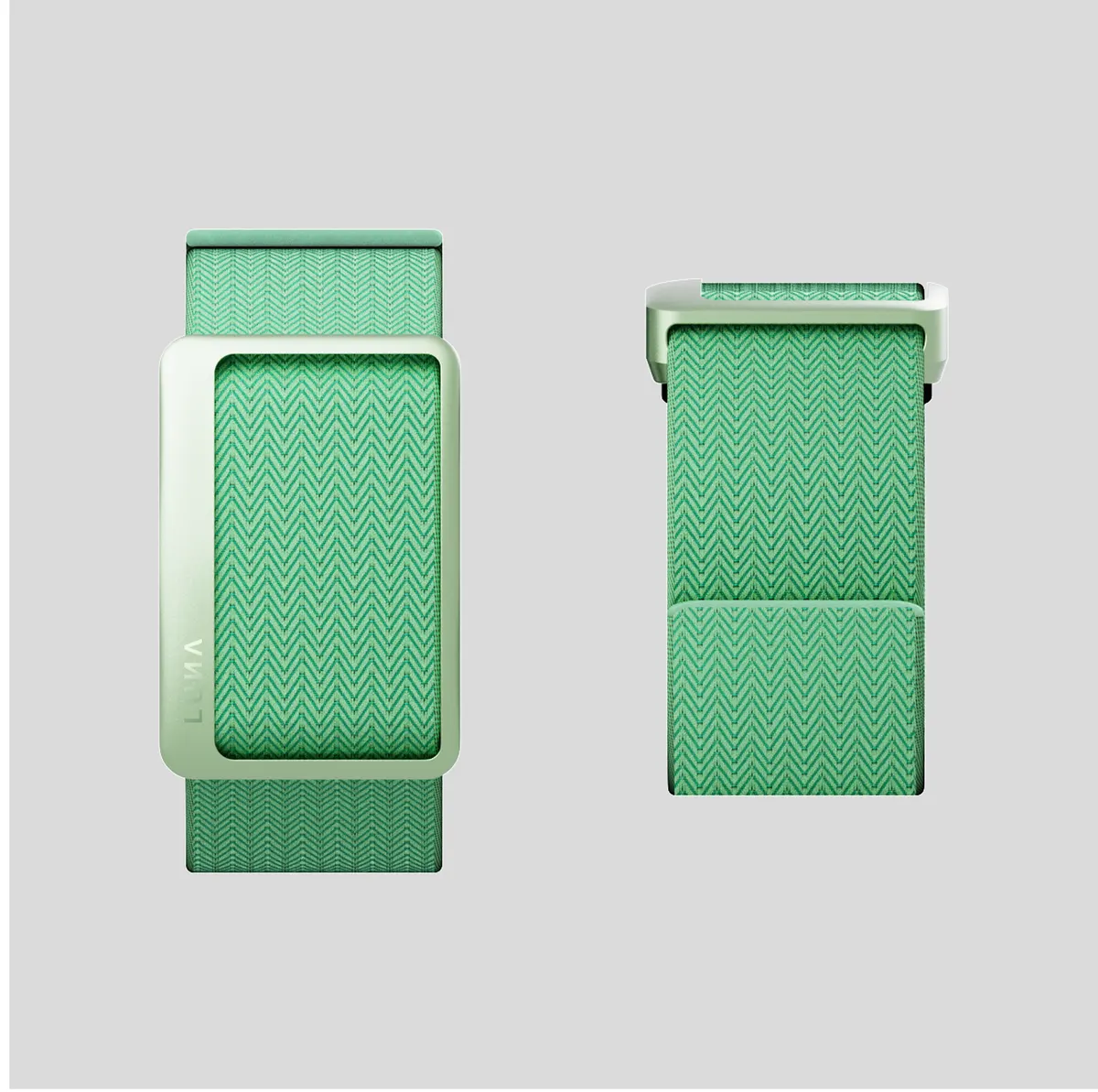
| Price (US, USD) | $149 one-timeRegular price $149 (listing checked 2026-11-18); Luna states a $119 promotion from 19 to 30 November 2026 only (Band only, worldwide, USD); confirm at checkout. |
|---|---|
| Subscription | None requiredThe Luna app and LifeOS are free for all users, including AI insights and coaching. |
| Battery | Up to 10 days (typical, per Luna)About 60 minutes to charge from empty with a magnetic charger. |
| Sensors | PPG optical heart rate, 3-axis accelerometer, 3-axis gyroscope, skin temperature |
| Reported metrics | Heart rate, HRV, skin temperature, training load, training effect, effort, heart rate zones, recovery |
| Water resistance | 5 ATM |
| Display | No display; haptic alerts, nudges and alarmsThe product page does not use the word screenless, so confirm against the listing if it matters. |
| Fit | Nylon hook-and-loop strap, Medium (240 mm) or Large (295 mm); wrist or upper arm |
| Integrations | Apple Health, Google Health Connect, Clue |
| Not yet available | Blood oxygen (SpO2) and VO2 Max are listed as coming soon |
| GPS | In-app GPS only, using the phone's GPS |
| In the box | Luna Band, charger with USB cable, extra M-L strapExtra straps are sold separately in other colours. |
| Weight | 24 g module |
The Luna Band is a screenless tracker that costs $149 once, needs no subscription, and publishes its heart rate validation so you can judge it. This review separates what the Band senses from what its software infers, and marks where the public evidence stops. It rests on Luna's own documentation checked on 2026-11-18, not on third-party testing.
Why does the Luna Band suit most screenless-tracker buyers?
Most of what a typical buyer wants is on the product page, and most of it is a plain strength:
- Price: $149 once, with no plan to renew.
- Software: the app and LifeOS are free for all users, including AI insights and coaching, per current terms.
- Battery: up to 10 days typical, with about 60 minutes to charge from empty.
- Build: 5 ATM water resistance, haptic alerts and a 24 g module that can be worn on the wrist or upper arm.
- Data: Apple Health and Google Health Connect syncing, plus Clue.
- Evidence: published validation against a Polar reference, covered below.
Taken together, that is a tracker you buy once and keep using. The gaps are real and listed later in this review, but none of them touches the daily use most readers buy a band for.
What does the Luna Band actually measure?
Luna lists four sensor inputs: PPG optical heart rate, a 3-axis accelerometer, a 3-axis gyroscope and skin temperature. PPG shines light into the skin and reads changes in blood volume, so heart rate is derived from a measured optical signal. HRV is typically calculated from the timing between beats, though Luna does not state its method.
Everything else is an estimate built on those inputs. Training load, training effect, effort and recovery are software scores, not direct measurements, and Luna does not state how each is computed. They suit trend tracking, and they are only as good as the signal underneath them, which is why the published validation below matters.
How reliable is workout heart rate?
Luna's product page reports all-day usage testing with 917 matched readings, a 0.987 Pearson correlation and a mean absolute error under 2, with a Polar reference. The page does not state the metric or units beside the 917-reading figures. It also shows beat-level waveform overlays against a Polar reference, and a second-by-second comparison against a Polar chest strap across sustained cycling load. These are Luna's own published results and were not reproduced by a third party.
Publishing the comparison is a point in the Band's favour, because it gives you something concrete to weigh. It is a strong starting point, not a settled result. Wrist optical sensors are commonly less dependable during intervals, gripping or strength work, and with a loose strap or cold skin. Luna says the band can be worn on the upper arm, which may help fit, though no accuracy data covers that position. For serious interval training, see the guide to workout heart rate on screenless bands and add a chest strap.
How does the Band handle overnight HRV and recovery?
Luna lists HRV, skin temperature and recovery among the Band's metrics, which are the inputs recovery trends depend on, and lists sleep analysis under its biomarkers. It shares the LifeOS app with the Luna Ring, so the Band is a natural starting point if you may add the Ring later.
Luna says the Ring remains the recommended device for the most precise, dedicated sleep tracking. It does not say how the Band's overnight accuracy compares, and sleep stages from any wrist band are modelled estimates rather than measurements.
For background, read how fitness bands measure sleep stages and HRV accuracy on wrist bands. If dedicated sleep staging is your only goal, that caveat matters more than any other point here.
Skin temperature, SpO2 and VO2 Max
Skin temperature is reported by the Band, and like all wrist skin temperature it reflects the surface, not core body temperature. It is a useful trend input alongside HRV for recovery. Blood oxygen (SpO2) and VO2 Max are listed as coming soon, so neither is available today.
What do the app, alerts and data access look like?
The Luna app runs on iOS and Android, with 60+ workout modes. Walks, runs, cycling, elliptical and rowing are detected automatically, so you do not need to start a session for everyday activity. Data can flow to Apple Health, Google Health Connect and Clue, which keeps your history portable.
The Band has no display, and alerts, nudges and alarms arrive as haptic vibration. In-app GPS uses the phone, so route tracking needs the phone with you; there is no built-in GPS. Because Luna's page does not say "screenless" in so many words, confirm the description against the listing if it matters to you.
How practical are the fit, battery and water rating?
The Band uses a nylon hook-and-loop strap in Medium (240 mm) and Large (295 mm), with a 24 g module, in Onyx Black, Aloe Green or Desert Beige. Because the strap is adjustable, it can sit on either wrist or the upper arm. A snug strap with steady skin contact generally gives a cleaner optical signal than a loose one, and sweat, hair or cold skin can weaken it.
Luna states up to 10 days of typical battery, which in practice means a charge roughly once a week to ten days, and about 60 minutes to charge from empty on a magnetic charger. Water resistance is listed as 5 ATM. The product page lists the Band, a charger with USB cable and an extra M-L strap in the box.
The Band is intended for adults aged 18 and over and is not a medical device, so use its outputs to inform training and habits, not to diagnose or treat anything.
How should you read the numbers it produces?
Think in layers. The bottom layer is a measured signal: optical pulse, motion and skin temperature. The middle layer is derived: heart rate, HRV and zones. The top layer is modelled: recovery, effort and training effect. Confidence commonly falls as you move up, so a recovery score deserves less trust than a heart rate reading, and a single day deserves less trust than a two-week trend.
That applies to any wrist band, not only Luna. It is why the Band's published heart rate comparison, which covers the bottom of the stack, is a useful anchor for the rest.
What do Luna owners say about support and the app?
Luna's own pages cannot tell you what ownership is like, this section draws on a selection of five-star Trustpilot reviews of Luna, read on 2026-11-18. Read them with care. The publisher chose them, so they are not Luna's overall rating and are not typical of all customers, and some were invited reviews. They are also about the Luna Ring and the Luna app and LifeOS, not the Luna Band, so they say nothing about Band hardware, accuracy or battery.
What these Luna Ring owners reported is consistent on service and software:
- Faults and delays that were fixed: a reviewer in Australia said a first ring was faulty and the local team reached out and fixed it quickly, while one in Poland said Luna reacted quickly to battery trouble and sent a new ring. A reviewer in Singapore noted the team is small, so replies may be slower, but said it took ownership when the ring battery depleted fast and resolved it.
- Delivery problems: a reviewer in Germany said a lost parcel led the helpdesk to search and send a second ring, and one in the UAE said support replied quickly about a delay and made sure the product arrived safely.
- The app: Jacob, in the US, said a sleep-logging issue in the Luna app was resolved quickly and has not returned. Kartik, in India, said the AI guidance in LifeOS helps him understand his data and what to do with it.
- Everyday use: a reviewer in India said the ring tracks key health metrics with commendable accuracy, and one in Spain said it met expectations with useful information and good customer care. The Australian reviewer also liked that no ongoing subscription is required.
Several of these owners hit a fault, a lost parcel or a delay first, and then described a quick fix. That is a fair reading of the selection: problems happen, and the people who wrote in were happy with the response. It is still a small, curated set, and it does not show how often problems occur.
For returns, Luna's refund policy (read 2026-11-18) says the Ring and the Band can be returned within 14 days of delivery, and the Band carries a 12-month limited warranty. Support is by support@lunazone.com or a support form, and Luna aims to ship within 2 business days. Check the terms for your region before you buy, because how they apply in the US has not been confirmed.
What does the Luna Band cost, and what is included?
The Band has a regular price of $149 (listing checked 2026-11-18); Luna states a $119 promotion from 19 to 30 November 2026 only (Band only, worldwide, USD); confirm at checkout. Per current product terms, no subscription is required: the app and LifeOS are free for all users, including AI insights and coaching. Terms can change, so check before purchase.
The one-time price is the main cost advantage. WHOOP One is $199 a year with the band included, so over 12 months Luna is $50 less, and over 24 months it is $149 against $398 if WHOOP renews at the listed price, a gap of $249. Google Fitbit Air is $99.99, which is $49 less at purchase, before the optional Google Health Premium from $9.99 a month. For a wider view of ongoing costs, see fitness trackers without a subscription.
Onyx Black is also sold on Amazon.com in the US, but the Amazon price and terms were not checked.
When is another device the better buy?
A few narrower cases point elsewhere:
- A display, built-in GPS or maps: a smartwatch, or Google's Fitbit Edge (from $179.99, with display, GPS and altimeter).
- ECG or blood pressure insights: WHOOP's Life tier on the MG band lists both, as wellness features. See Luna Band vs WHOOP.
- The longest claimed battery: WHOOP claims 14+ days against Luna's up to 10.
- SpO2 and breathing rate now: Google Fitbit Air lists both at $99.99. See Luna Band vs Google Fitbit Air.
Who should buy the Luna Band?
Buy the Luna Band if you want a tracker with no display, heart rate, HRV and recovery trends, free AI coaching, and a one-time $149 cost. It suits most readers shopping for a screenless band. Its accuracy evidence is the maker's own, so treat early readings as trends and compare against a reference if precision matters. Skip it only if you need SpO2, GPS, a display or best-in-class sleep tracking today. This is a wellness device, not a medical device, and is intended for adults aged 18 and over.
Sources
- Luna Band product page, LunazoneRead November 18, 2026
- WHOOP membership pageRead November 18, 2026
- WHOOP support: WHOOP basicsRead November 18, 2026
- Google Store: Google Fitbit AirRead November 18, 2026
- Google Store: watches and trackersRead November 18, 2026
- Luna refund policy, LunazoneRead November 18, 2026